Structural Drying in Newton, MA
Water that has been extracted is not gone. It sits in framing, subfloor and plaster and keeps damaging them. The drying team sizes air movers and LGR dehumidifiers to the room and proves the result with daily readings.
(888) 629-3140Call for Newton structural drying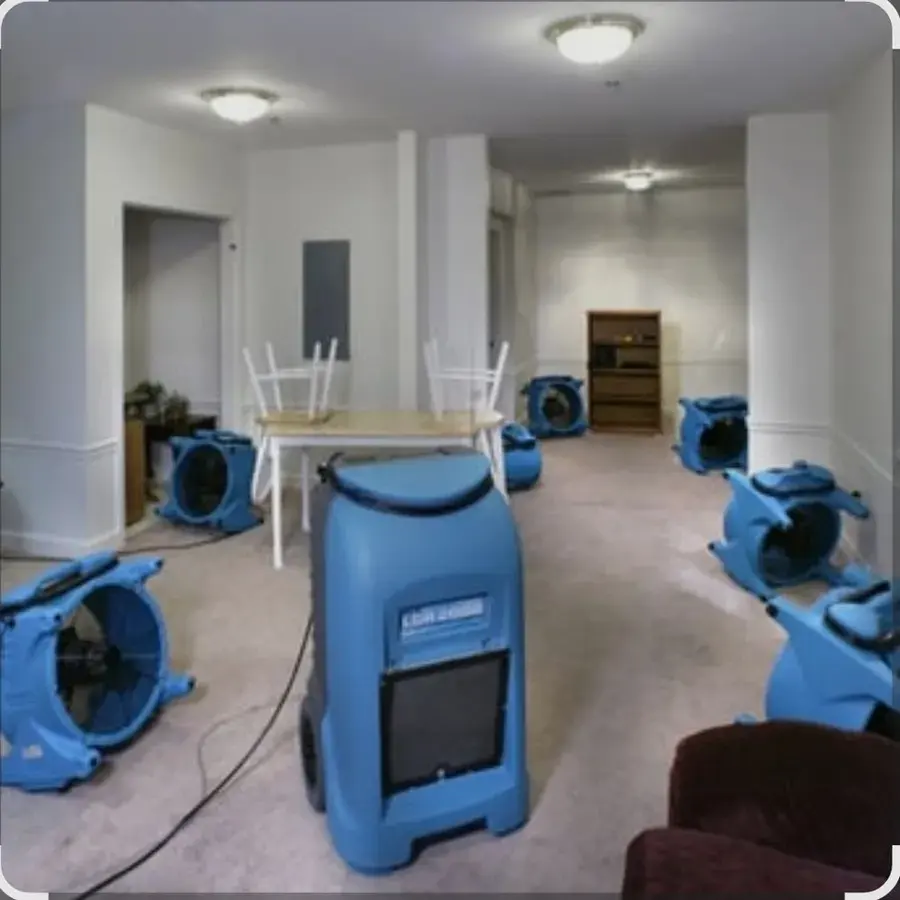
Drying is a science of vapor. Air movers lift moisture off wet surfaces, and LGR dehumidifiers pull it out of the air so it cannot settle back. The two work together, and the balance depends on the room, the materials and the weather outside.
First steps for structural drying and dehumidification in Newton
- I
Keep doors and windows shut
Closed rooms let the dehumidifiers work on the moisture instead of fresh outdoor air.
- II
Leave the equipment running
Air movers and dehumidifiers are loud, but switching them off stalls the drying.
- III
Keep the heat steady
Moderate warmth speeds evaporation, so leave the thermostat as the crew sets it.
- IV
Do not rehang or repaint
Wait for the final readings before closing walls, laying flooring or painting.
How structural drying and dehumidification is handled in Newton
The tech who does the walkthrough maps moisture before any equipment goes down, so the drying plan follows what is actually wet. Equipment stays until the readings say dry, not until it looks dry.
- 1
Map the moisture
Meters and a thermal camera mark every wet surface and set the baseline.
- 2
Size the equipment
Air movers and dehumidifiers are chosen by the class and category of the loss.
- 3
Monitor daily
Moisture and psychrometric readings are logged, and the equipment is adjusted.
- 4
Release on proof
Equipment leaves only when wet materials read within the dry goal.
What does structural drying and dehumidification cost in Newton, MA?
In Newton, MA, structural drying usually costs $1,000 to $20,000. The class of the loss, the number of rooms and floors wet, whether plaster, hardwood or masonry is involved and the days of equipment set the price.
Light loss in one area
$1,000 to $3,000Several rooms, heavier loss
$3,000 to $8,000Dense materials, Class 4
$8,000 to $20,000Ranges are typical, not a quote: category of water, square footage, material class and how fast drying started move the number most. Run the water damage cost calculator for a closer range.
How drying works in a Newton house
The crew starts with a moisture map of every wet surface. The class and category of the loss set how much equipment goes in: more for plaster, hardwood or finished lower levels, less for a single hard floor. Mats pull water up through wood, and wall cavities get air through small openings. Containment keeps the dry air where it is needed.
Proof, not guesswork
A dry-out is finished by the numbers. Moisture content and psychrometric readings are logged every day, and the crew compares wet materials with a dry reference taken from an unaffected room. Equipment leaves when the readings land within 2 to 4 points of that reference, and the log goes to the adjuster. A surface that feels dry can still hold water deep in the wood or plaster behind it, which is why touch alone is never the test.
Drying in a cold, wet season
Cold air holds little moisture, so winter drying leans on dehumidifiers and gentle heat, with windows closed. In a heavy rainy spell humid outside air works against the job, so doors stay shut. Drying follows extraction, covered at water extraction, and for a lower level that flooded see basement flooding cleanup.
Structural drying and dehumidification across Newton and nearby towns
The drying team works throughout Newton, including Newton Centre, Newton Corner, Auburndale and Oak Hill, across ZIP 02458, 02459 and 02466 and every other village.
The same service nearby: structural drying and dehumidification in Waltham, Watertown, Belmont.
Structural Drying and Dehumidification questions in Newton, MA
What is the difference between extraction and drying?
Extraction removes liquid water. Drying removes the moisture left in materials, as vapor. Both are needed, in that order.
Why do the machines run for days?
Moisture leaves dense materials slowly. Plaster, hardwood and framing give it up over days, so equipment stays until readings match the dry reference.
What does LGR mean?
Low grain refrigerant dehumidifiers pull more moisture from the air at low humidity than a standard unit, which keeps drying going late in the job.
Can walls be dried without opening them?
Often, with air pushed into the cavity through small openings and a dehumidifier running. A wall that stays wet is opened.
Will the electric bill go up?
Yes, for the days the equipment runs. The crew's log helps document that extra use for the claim.
How do I know it is really dry?
Daily moisture readings are compared with an unaffected reference. The goal is within 2 to 4 points, and the log is kept for the claim.
Related water damage services in Newton
Is your Newton house really dry?
Surface dry is not the same as dry. The drying team sizes the equipment and keeps it running until the readings prove the structure is dry.
(888) 629-3140Start Newton structural drying