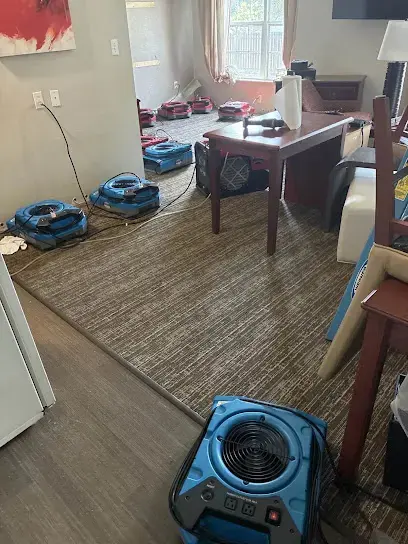
Waltham has a long row of office and lab buildings along Route 128 and Totten Pond Road. When water gets into one of them, the cost is rarely only the wet floor. It is the days of work that stop while the space dries.
Key takeaways
- Water damage in an office or lab is judged by two clocks: how fast the structure dries and how long the business can be disrupted.
- The first call belongs to facilities and building management, who can close the water supply to the affected zone.
- Protect equipment, records and samples first, and photograph the loss before moving anything.
- Phased drying lets part of a floor stay in use while another part is worked on.
- The building owner, the tenant and the insurers each need a record, so documentation starts on day one.
Why commercial water damage is a different job
A house has one owner and a handful of rooms. An office or lab building has an owner, tenants, a facilities team and often several insurers, and every one of them has a stake.
The building also has things a house does not. Suspended ceilings hide pipes and ductwork, raised floors hold cabling, and lab benches and equipment can cost more than the room around them.
Because of that, commercial water damage work is planned as much as it is performed.
- Multiple parties need to approve the plan
- Ceilings and floors hide the water path
- Equipment and records can be worth more than the finishes
- Downtime has a cost of its own
Where the water comes from in these buildings
Waltham's office and lab buildings along Route 128 and Totten Pond Road carry the same basic water risks as any large building, and most failures begin in a few familiar places.
A burst pipe above a ceiling and a roof leak during a storm are two of the most common starts.
A single failure in a supply branch, a sprinkler head, a roof drain, a rooftop unit or an upstairs restroom can send water down through several floors.
- A burst or leaking supply pipe above a ceiling
- A failed sprinkler head or a damaged sprinkler branch
- A roof leak during a storm or after snow melts
- An overflowing restroom or kitchen on an upper floor
- Storm water entering at a loading dock or ground level door
The first steps for facilities and tenants
Calm, quick action in the first stretch decides how large the job becomes.
Stop the source and secure the area
Facilities staff close the valve that feeds the zone, if one is available, and keep people out of the wet area. Power to wet ceilings, floors and outlets is shut off by someone qualified to do it.
- Close the water supply to the zone
- Keep staff out of wet or sagging areas
- Turn power off safely at the panel
- Tell the building owner and the tenants below
Protect what matters most
Cover or move computers, files, samples and equipment. Plastic sheeting over a lab bench can save a great deal of cost.
Anything that is heavy or hard to move waits for the restoration team, with the same record kept as the rest.
Document before anything is moved
Photographs and short videos of the ceiling, floors and equipment, with the date and the time, make later conversations with insurers simpler.
How phased drying keeps an office open
A building that has to keep working cannot be shut down while it dries. Phased drying splits the affected space into zones and works through them in order.
In one phase, a conference room might be sealed and dried while the open office next to it stays in use. In the next, the team moves its equipment to the area that was wet second.
Containment, quiet equipment where possible and after hours work all help a tenant keep operating.
- The wet area is mapped with moisture meters and a thermal camera
- Zones are closed off with barriers
- Equipment is placed in the zone being dried and moved on as readings reach a dry reference
- Work can be set to times that suit the tenant
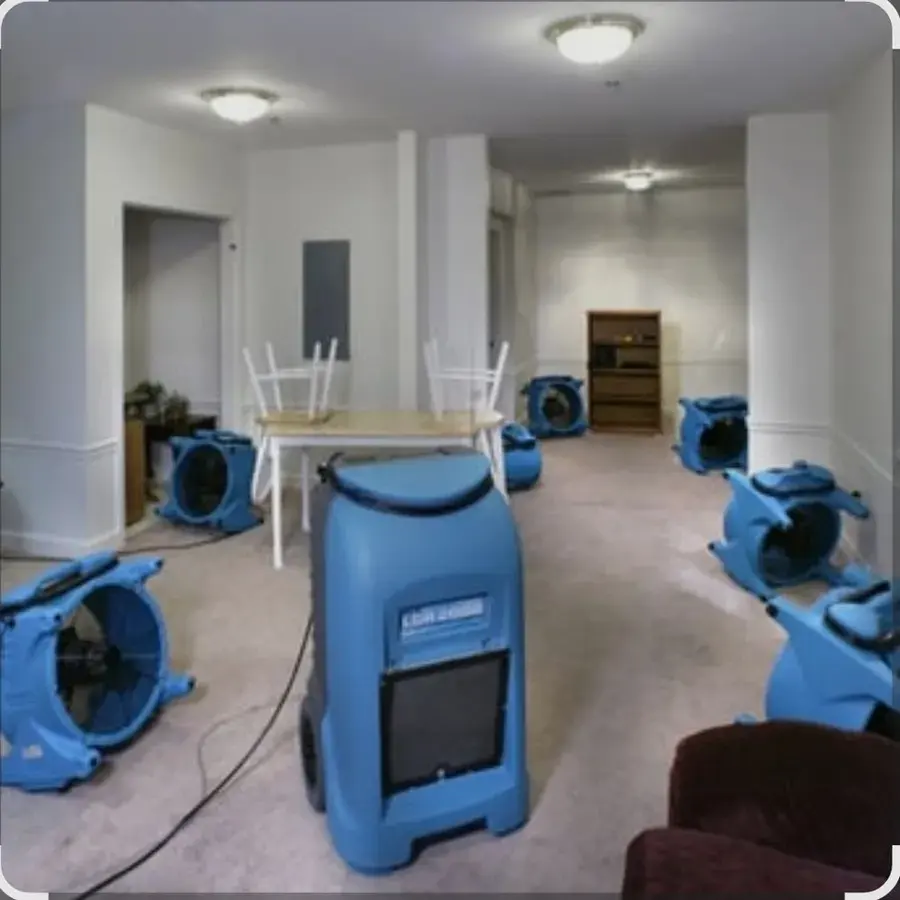
Drying ceilings, floors and walls to a standard
Structural drying follows the IICRC S500 standard and relies on readings, not on how a surface looks.
Wet ceiling tiles and insulation are usually removed because they hold moisture. Carpet tile, sealed concrete and metal framing can often be dried in place when they are cleaned.
Air movers and dehumidifiers are balanced to the size of the space, and the team returns to take readings until each zone matches a dry reference.
- Ceiling tiles and insulation that soaked up water are removed
- Carpet tile and floor coverings are lifted where wet
- Walls are checked behind finishes before they are closed
- Readings are written down at each visit
Preparing as a tenant or a manager
A little preparation turns a bad night into a managed event. None of it is complicated, and most of it costs only time.
A short written plan that names who closes which valve, who calls the building owner and where the equipment covers are kept is worth more than a long binder nobody reads.
- Mark shutoff valves for each zone on a floor plan
- Keep plastic sheeting and a few tarps near critical equipment
- Keep a current list of contents and their values
- Agree in advance who speaks to the owner, the tenants and the insurers
- Walk the space after a storm and look at ceiling tiles for stains
Records for the owner, the tenant and the insurers
A commercial claim often has to satisfy more than one party. A building owner's policy may cover the structure while the tenant's covers contents and lost operations.
The record the restoration team keeps becomes shared evidence: photographs, moisture logs, a list of removed materials and a daily log of equipment.
For a tenant planning, water extraction and the first drying steps are the pieces that stop the damage from growing, so they are worth getting in place early.
- Dated photographs from before cleanup
- A list of damaged equipment and contents, with values
- Moisture readings and equipment logs from the restoration team
- A note of who was told and when, including the owner and the tenants
Questions
Can an office stay open during water damage drying?
Often part of it can. Phased drying closes off one zone at a time, so unaffected areas stay in use while the wet zone is dried.
Who should be told first when a leak starts in a lab or office?
Facilities or building management, who can close the water supply to the zone. The restoration team is called right after the supply is stopped.
Are ceiling tiles saved after a leak?
Usually not. Tiles and insulation that absorbed water hold moisture, so they are normally removed and replaced.
What records does an insurer expect?
Photographs, a list of damaged contents, moisture readings and a log of equipment and visits. The restoration team's drying logs form much of that file.
Is the same approach used for a storefront near Moody Street?
The steps are the same: stop the source, protect contents, extract water and dry to a standard. Smaller buildings usually have fewer zones and parties.